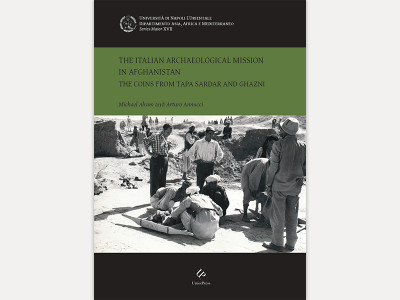
The volume presents a comprehensive study of the coins discovered in the Ghazni region during the excavations conducted by the Italian Archaeological Mission in Afghanistan between 1956 and 1978, in particular at the Buddhist complex of Tapa Sardar and at several Islamic sites.
This work brings to light an otherwise lost corpus of excavated coins. Although the original specimens are no longer available, the research was possible thanks to the archival documentation and plaster casts produced by the first members of the Mission.
The catalogue includes 227 coins spanning a wide chronological range, from antiquity to the modern period, reflecting the long and complex history of the Ghazni region. This material significantly contributes to our understanding of the political and economic developments of the area over time.
The coins are organised into two main sections: the first covers issues from the 2nd to the 8th centuries, while the second includes material from the 9th to the 20th centuries. Each section is accompanied by a detailed numismatic analysis. The volume is further enriched by updated archaeological contributions on Tapa Sardar by Giovanni Verardi and on the Ghaznavid Palace and the House of Lustrewares by Roberta Giunta.
Continuing the long-standing tradition linking the “Viennese Numismatic School” with the Italian Archaeological Missions in Afghanistan and Pakistan, this publication is the result of a fruitful collaboration between the Università di Napoli L’Orientale, the ISMEO, the Kunsthistorisches Museum, the Austrian Archaeological Institute, and the Austrian Academy of Sciences.
The volume is available in Open Access HERE